Blog
AI is Making ERP Smarter: The Next Evolution of Enterprise Intelligence
August 31, 2026
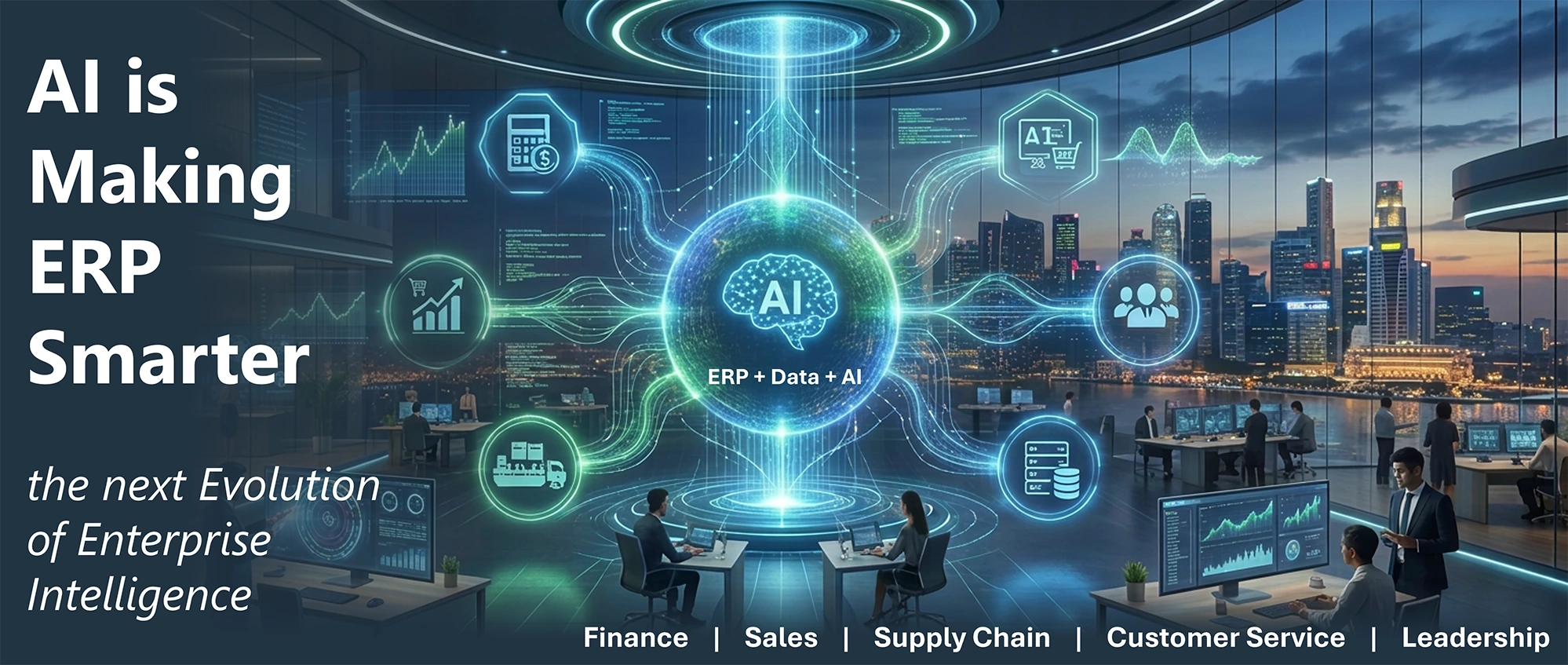
For decades, ERP systems have served as the system of record, capturing transactions, managing finances, tracking inventory, and supporting critical business operations.
But businesses are now asking a bigger question:
What if ERP could do more than tell us what happened?
What if AI could help us understand why it happened, what may happen next, and where we should focus our attention?
That is where AI-powered ERP is revolutionizing the game. From System of Record to System of Intelligence, traditional ERP helps businesses record and report data. AI helps businesses understand, predict, and act. Instead of navigating multiple reports or spreadsheets, users can ask questions in natural language.
Which customers are most likely to delay payment?
Why did margins decline this quarter?
Which inventory items are at risk?
Which sales opportunities need attention?
The value isn't just faster reporting. It is turning enterprise data into actionable business intelligence.
AI Is Transforming the ERP Ecosystem
AI is already becoming part of leading enterprise platforms. Microsoft is embedding Copilot across Dynamics 365, SAP is advancing AI with Joule, Salesforce is integrating Einstein AI, and Snowflake is bringing AI capabilities closer to enterprise data.
Across finance, sales, supply chain, customer service, and operations, AI can help organizations:
- → Finance: Analyze cash flow, identify anomalies, and support forecasting.
- → Sales: Prioritize opportunities and summarize customer interactions.
- → Supply Chain: Identify inventory risks and demand patterns.
- → Customer Service: Summarize cases and surface relevant information.
- → Leadership: Ask business questions and gain faster access to insights.
But AI Alone Isn't Enough
Organizations may have ERP, CRM, SharePoint, data warehouses, Power BI, and multiple AI platforms. But these systems often operate within their own ecosystems.
Your financial data may sit in ERP. Customer information may live in CRM. Documents may be stored in SharePoint. Analytics may run through a separate data platform.
So the real question isn't:
"Do we have AI?"
It is:
"Can our AI understand our business as a whole?"
Enterprise AI requires trusted data, connected systems, business context, security, and governance to deliver meaningful results.
Simply connecting an LLM to an ERP does not automatically produce enterprise intelligence.
The Next Step: Connected Enterprise Intelligence
The future isn't about replacing ERP; it's about making ERP smarter.
Platforms such as KDAPT are designed to serve as an Enterprise Intelligence Layer, connecting ERP, CRM, databases, documents, and other business systems to AI-powered analytics.
The objective is simple:
AI provides the intelligence. Business leaders remain in control of the decision-making.
As organizations move from traditional reporting toward Generative AI, conversational analytics, predictive insights, and intelligent decision support, the opportunity is no longer limited to automating processes.
It is intended to fundamentally improve how businesses understand their operations and make decisions.
“The future of ERP isn't ERP vs. AI.
It's ERP + Data + AI working together.”
Ready to get started?
Partner with KARYA Technologies to transform your ERP into a connected, AI-powered intelligence platform.