Blog
Why GP Still Runs Critical Finance Operations and How to Modernize It?
July 10, 2026
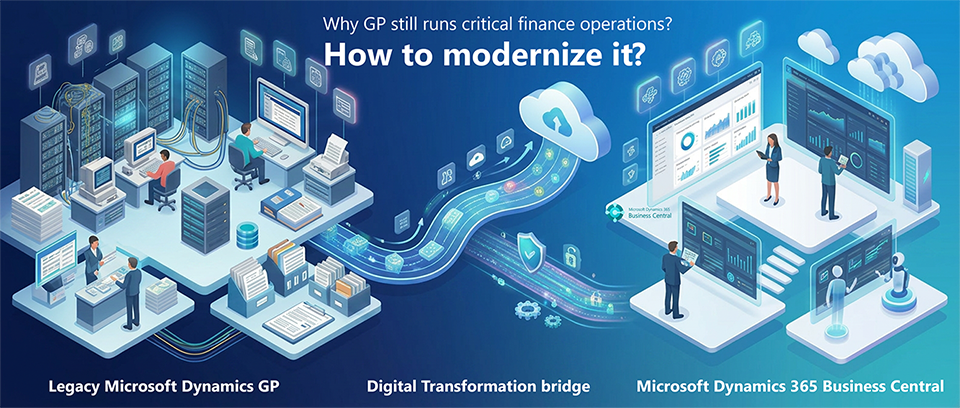
For over two decades, Microsoft Dynamics GP (originally Great Plains) has been a trusted financial management solution for organizations across industries. Many businesses still rely on it for core accounting, payroll, financial reporting and day-to-day finance operations.
However, evolving business needs and Microsoft's planned end of support for Dynamics GP are prompting organizations to reassess their ERP strategy and move toward a modern cloud platform.
As a result, many businesses are now exploring ways to modernize finance systems while maintaining continuity and minimizing disruption.
Why Finance Teams Still Rely on GP
Dynamics GP continues to support critical finance operations for several reasons:
- → Reliable Financial Management: GP provides stable and dependable capabilities for general ledger, accounts payable, accounts receivable, and payroll processing.
- → Familiar User Experience: Finance teams have years of experience working with GP, making everyday operations efficient and consistent.
- → Business-Specific Customizations: Many organizations have implemented third-party solutions and customizations that support their unique business processes.
These strengths have helped Dynamics GP remain an important part of finance operations for many years.
Challenges of Staying on Legacy ERP
Although Dynamics GP continues to perform well, legacy on-premises ERP systems can create operational challenges as business requirements grow.
- → Limited Real-Time Business Insights: Finance teams often spend time manually consolidating data, delaying reporting and decision-making.
- → Ongoing Infrastructure Management: Maintaining servers, backups, security, and system availability increases IT effort and costs.
- → Limited Access to Modern Cloud Capabilities: Legacy ERP systems cannot fully leverage AI, automation, automatic updates, and seamless Microsoft integrations.
The Business Impact of the Dynamics GP Sunset
Microsoft has announced the end of product support for Dynamics GP. While existing GP environments will continue to run, businesses will no longer receive future enhancements, regulatory updates, or mainstream support.
This creates real business risk. Over time, organizations may face compliance challenges, security concerns, integration issues, and higher maintenance costs.
Planning a modernization strategy now can help protect business continuity and support a smoother move to a modern cloud ERP platform.
The Modernization Blueprint: Moving Forward
Modernizing your finance operations means moving proven processes to a scalable cloud platform while improving efficiency and growth.
-
Phase 1
Audit
Map custom fields and critical ISVs
-
Phase 2
Cleanse
Remove outdated data and archive historical records
-
Phase 3
Migrate
Transition to a modern cloud ERP such as Dynamics 365 BC
For many Dynamics GP customers, Microsoft Dynamics 365 Business Central is the recommended modernization path. It offers cloud capabilities, continuous updates, stronger security, AI features, and integration with Microsoft 365 and Power BI.
A successful modernization strategy typically focuses on three priorities:
- → Simplify Business Processes: Review existing customizations and retain only those that continue to deliver business value.
- → Prepare High-Quality Data: Clean and validate financial and master data before migration to improve reporting and operational efficiency.
- → Follow a Structured Migration Plan: Careful planning, testing, and user adoption help minimize disruption and support a smooth transition.
How KARYA Technologies Supports Your Migration?
KARYA Technologies helps organizations assess their Dynamics GP environment and plan a smooth migration to a modern cloud ERP platform.
Start Planning Your Modernization Journey
With Dynamics GP approaching the end of support now is the time to plan ahead.
Ready to get started?
Contact KARYA Technologies to build your migration roadmap to Microsoft Dynamics 365 Business Central.