KARYA Article
Legacy ERP to Microsoft Dynamics 365
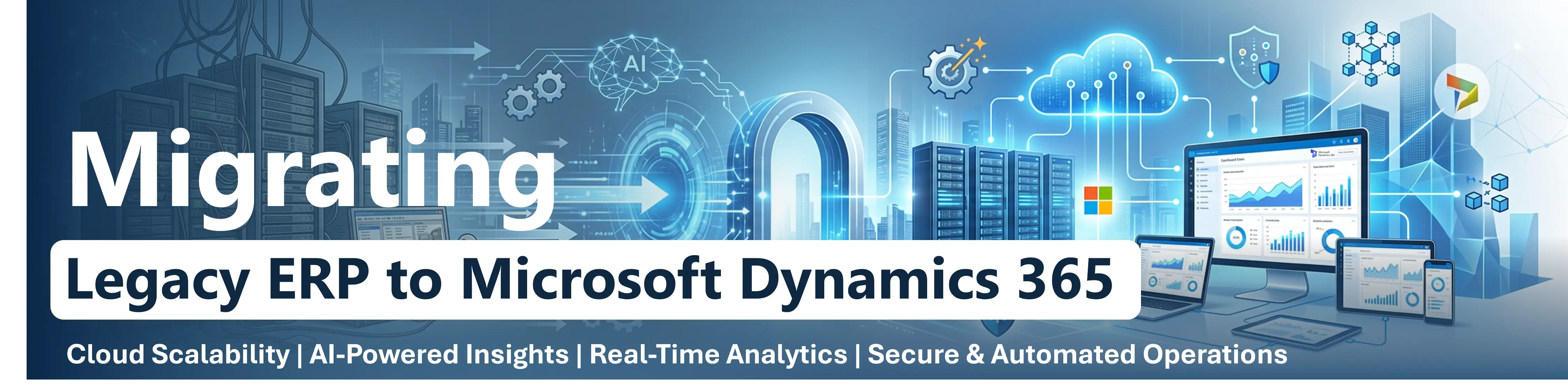
In today's enterprise landscape, operational efficiency remains a cornerstone of sustainable growth. Yet many organizations still lose 20% to 30% of their annual revenue because of fragmented, manual processes and broken workflows.
As many legacy platforms reach end-of-life (EOL) or end-of-support, businesses no longer receive security updates, compliance improvements, bug fixes or product enhancements, increasing operational and security risks.
Migrating to Microsoft Dynamics 365 provides a secure, cloud-based ERP platform with real-time insights, automation, Microsoft integration, and scalability to improve efficiency, collaboration, and future growth.
Legacy ERP Migration Paths
Microsoft offers two primary ERP solutions based on business requirements:
- Microsoft Dynamics 365 Business Central – Best suited for small and medium-sized businesses.
- Microsoft Dynamics 365 Finance & Supply Chain Management – Designed for large enterprises with complex operations.
According to Gartner research, demand for digital transformation and enterprise application development is growing at least five times faster than IT’s capacity to deliver them. To bridge this gap, organizations must adopt low-code hyperautomation strategies that democratize development across business units.
Common Migration Paths
Microsoft ERP Migrations
- Microsoft Dynamics GP → Dynamics 365 Business Central
- Microsoft Dynamics NAV → Dynamics 365 Business Central
- Microsoft Dynamics SL → Dynamics 365 Business Central
- Microsoft Dynamics AX → Dynamics 365 Finance & Supply Chain Management
Third-Party ERP & Accounting Migrations
The following ERP and accounting systems can be migrated to the appropriate Microsoft Dynamics 365 solution based on business size, complexity, and operational requirements:
- QuickBooks
- Sage
- Tally
- Xero
- Oracle NetSuite
- SAP Business One
- Odoo
- Epicor
- MYOB
- Acumatica
Why Upgrade from a Legacy ERP?
Legacy ERP systems can limit business growth as technology evolves. As these systems reach end-of-life, they no longer receive vendor support, security updates, or new features, increasing business risks and maintenance costs. With Microsoft Dynamics GP in its sunset phase, now is the right time to migrate to Microsoft Dynamics 365.
- High Maintenance Costs: Maintaining on-premises servers, aging hardware, and outdated software requires continuous investment. Businesses also spend significant time and resources managing upgrades, customizations, and system maintenance instead of focusing on innovation.
- Limited Integration: Many legacy ERP systems were not designed to work with today's cloud applications and business tools. This results in disconnected systems, duplicate data entry, manual processes, and limited visibility across departments.
- Security and Compliance Risks: As older ERP platforms reach the end of vendor support, they no longer receive regular security updates or compliance enhancements, increasing the risk of cyber threats, data breaches, and regulatory challenges.
- Lack of Business Agility: Businesses today need to adapt quickly to new customer needs and market changes. Outdated systems can make it hard to automate tasks, adopt new technology, enter new markets, or support work-from-home and hybrid work setups.
Benefits of Microsoft Dynamics 365
- Cloud-Based Scalability that grows with your business while reducing infrastructure costs.
- AI-Powered Insights using Microsoft Copilot to improve decision-making and automate routine tasks.
- Seamless Integration with Microsoft Teams, Outlook, Excel, Power BI, and the Microsoft Power Platform.
- Real-Time Reporting through centralized data that enables faster, more informed decisions.
- Enterprise-Grade Security with automatic updates, compliance management, and built-in data protection.
These capabilities help organizations improve operational efficiency while reducing manual effort across finance, sales, inventory, and supply chain operations.
Modern ERP Migration Strategy
A successful ERP migration begins with careful planning. Assess your current system, clean and validate your data, map your business processes to Microsoft Dynamics 365, and test the solution in a sandbox environment. User training, end-to-end testing, and post-go-live optimization ensure a smooth transition.
Conclusion
Migrating from a legacy ERP to Microsoft Dynamics 365 is a strategic step toward greater efficiency, scalability and business agility.
Ready to modernize your legacy ERP? KARYA Technologies helps businesses migrate to Microsoft Dynamics 365 Business Central and Dynamics 365 Finance & Supply Chain Management, ensuring a smooth transition and lasting value.
Want to know more? Please reach us at info@karyatech.com For more about our expertise, please visit www.karyatech.com.