Articles
The UAE e-Invoicing Mandate: Is your Enterprise ERP truly ready?
The UAE’s tax ecosystem is undergoing its most radical transformation since the introduction of VAT. The Federal Tax Authority (FTA) is phasing out traditional paper and PDF invoicing in favor of a mandatory Electronic Invoicing System (EIS). Operating under a strict Continuous Transaction Control (CTC) model, this new framework requires all B2B and B2G invoices to be cleared, signed, and reported in real time.
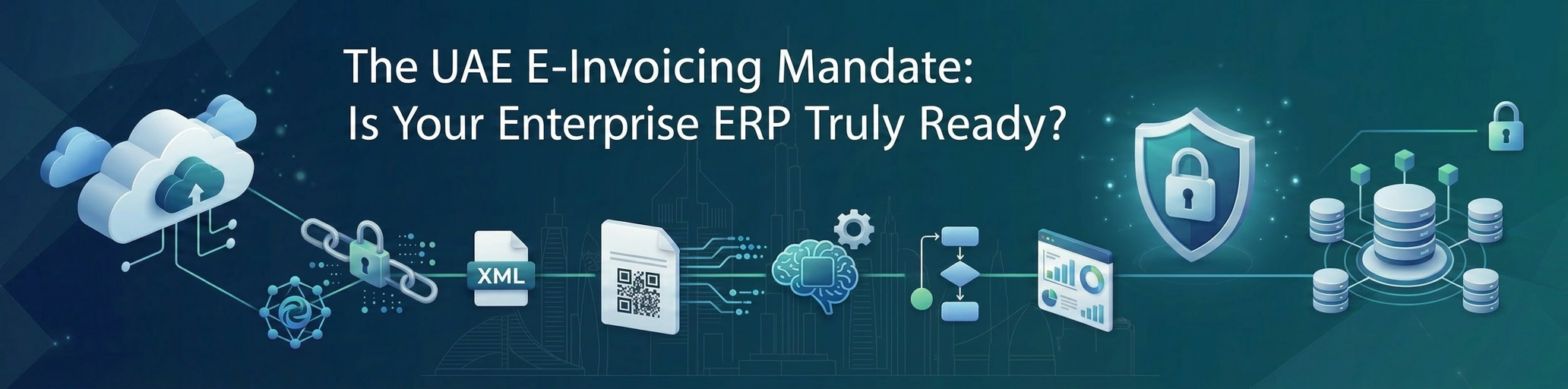
For organizations running enterprise software ecosystems, this is not a routine tax patch. It is a fundamental shift in how core platforms handle and transmit transactional data. Waiting until the official enforcement deadline to prepare risks system lockouts, operational delays, and severe non-compliance penalties.
At KARYA Technologies, we specialize in implementing, supporting, and upgrading market-leading ERP systems. Here is what you need to know to secure your transactional pipeline.
ERP Compliance Requires More Than a Software Patch
While major software vendors continuously update their global compliance features, installing standard localized patches does not automatically ensure your business's compliance.
The UAE framework is built on a decentralized 5-Corner Model powered by the Peppol network. While your system can package your raw transactional data, it does not automatically route it to the government or to your customers.
To bridge this gap, every business must integrate its ERP with a domestic, FTA-accredited Accredited Service Provider (ASP). The ASP serves as the secure intermediary that validates your data, applies a cryptographic seal, and transmits it to the FTA instantly.
- Your ERP System (KARYA Managed): Generates and structures raw transactional data.
- Accredited ASP (Secure Gateway): Validates data, applies cryptographic signatures, and routes messages.
- Federal Tax Authority (Real-Time Cleared): Instantly receives, clears, and logs the compliant electronic invoice.
Technical Mapping Across Your ERP Ecosystem
Depending on which platform drives your business operations, the compliance roadmap requires tailored integration strategies:
Microsoft Dynamics 365 (F&O & Business Central)
Cloud-enabled Dynamics 365 environments use built-in Electronic Invoicing engines. However, significant configuration is required to map internal data elements to the unique PINT-AE XML schema, ensuring split-second validation without creating batch-processing bottlenecks.
Legacy & On-Premises Systems (Dynamics AX / NAV / GP)
If your operations still rely on robust on-premises systems such as Dynamics AX, NAV, or GP, your - enterprise systems cannot natively communicate with modern real-time APIs because it lacks the network architecture needed to connect to modern endpoints.
- The KARYA Solution: We build custom middleware pipelines that securely extract, enrich, and convert your legacy database tables into fully compliant, modern digital streams.
4 Critical System Gaps You Must Address Now
To avoid failed invoices and immediate rejections by the FTA network, implementation teams must address four critical areas within the ERP environment:
- Line-Level VAT Logic: The FTA requires all commercial discounts and VAT calculations to be broken down and itemized line by line in UAE Dirhams (AED). Legacy configurations that calculate tax as a single lump sum in the invoice footer will be automatically rejected.
- Master Data Debt: Missing Tax Registration Numbers (TRNs), invalid addresses, or missing Peppol Participant IDs will break the XML data stream. Your master records across customers and vendors must be fully audited and cleansed.
- Complex Billing Workflows: Advance vendor payments, milestone project billing, and credit notes must follow strict structural rules to remain valid within the continuous control network.
- CRM Synchronization: If you use front-end applications like Dynamics 365 CRM or Salesforce to log customer billing profiles, these fields must align perfectly with your backend ERP data to avoid validation errors during data extraction.
The Regulatory Timeline: Knowing Your Deadline
Enterprise
Criteria: Annual Revenue ≥ AED 50 Million
ASP Selection Deadline: October 30, 2026
Mandatory Go-Live: January 1, 2027
Mid-Market
Criteria: Annual Revenue < AED 50 Million
ASP Selection Deadline: March 31, 2027
Mandatory Go-Live: July 1, 2027
Secure Your Business Continuity with KARYA Technologies
Transitioning to e-invoicing is a complex data project that requires deep technical expertise, tax logic configuration, and thorough end-to-end testing. As a trusted ERP implementation and fully managed services partner, KARYA Technologies handles the heavy lifting for you, ensuring your systems remain fully compliant without disrupting your daily business operations.
Claim Your Free 30-Minute ERP Readiness Assessment
Don’t leave your regulatory compliance to chance at the last minute. Contact our enterprise software consulting team today to lock in a complimentary 30-minute system diagnostic (Reserve your complimentary 30-minute system diagnostic today and uncover opportunities to improve performance). We will review your current ERP setup, map out your implementation wave, and immediately identify any gaps.
Contact us - Click Here to Schedule Your Free KARYA Readiness Assessment.